Located in the west end of Ottawa, Goulbourn Museum shares the story of the 100th Regiment of Foot, settlement & early pioneer life. We'll be blogging about events, museum work & new artefacts.
Sunday, 25 September 2011
Reading about the War of 1812
Tuesday, 13 September 2011
What a fun-filled September!
Monday, 22 August 2011
Going Fishing for Our History
Historical research is like fishing in the Jock River. You cast and cast a line into murky waters. For Goulbourn Museum’s new travelling exhibit, I did research on the 1805 maiden voyage of the 100th Regiment of Foot. I went to the good fishing places as the late A. Barry Roberts, author of the outstanding history book, For King and Canada, at the Library Archives of Canada to make digital copies of British Colonial Office letters about the military disaster when three of the regiment’s five troopships were wrecked at sea.
Back home, a computer keyboard was my fishing pole -- type in 100th regiment 1805 shipwreck, and see the fishtails swirling around. One website lead to another as I got luckier in snagging narratives about the tall ship Nais, also known as Aeneas, off Newfoundland and the brig Two Friends, off Cape Breton Island. More sources are available for the Nais or Aeneas, since the 340 deaths of 347 aboard rates international prominence on the United Kingdom’s major disasters list since 1707 (see Aeneas in third group of 300-499 fatalities here ).
Consequently, historians and journalists have been reporting on this maritime tragedy for 200 years, including Terence Grocott in his 2002 collection, Shipwrecks of the Revolutionary & Napoleonic Eras (see above cover and page). Goulbourn Museum bought the book after seeing it as a primary source for the Wikipedia item.
Kurt Johnson, Munster
Mail to: Kurt@goulbournmuseum.ca
Tuesday, 9 August 2011
Exciting finds
Monday, 8 August 2011
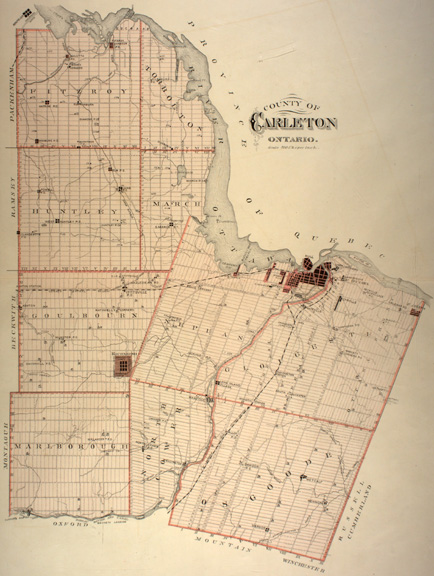
Carleton County Copy Books - from guest blogger Jim Stanzell
Thursday, 4 August 2011
Down On Goulbourn's Farm - - Kid's Workshop


At this unique, one-of-a-kind workshop, children will get to each create their very own Goulbourn farm. Each child will decorate a barn, build their own box animals, play games, and even be the first to take a museum scavenger hunt. Supplies will be provided. Parents are not required to stay at this event.
The event will take place at the Museum on Tuesday August 23rd from 1-4 p.m. Children will have a blast creating these beautiful one of a kind crafts. Designed for children ages 7-11, this event is sure to educate children on local pioneer history while creating crafts and experiencing fun pioneer games. Please call 613-831-2393 to reserve your spot now, $20 per child.
In addition to the crafts and activities, visitors are encouraged to explore the Museum’s feature exhibits, including our popular Village Store. Please note: our History Centre will be closed for the day.
The
Tuesday, 2 August 2011
Our 'Modern' Dictionary


Last week, I stumbled upon a treasure. I picked up a rather non-descript looking book, meaning that it resembled a great many other books in any community museum collection; neither small nor large, brown leather creased and cracked cover which had become detached, the lettering on the spine faded. Lifting off the detached front cover of the book, I read the main title – “The Modern Dictionary of Arts and Sciences” (which in this year of 2011, made me chuckle) and then the sub title – “ Or Complete System of Literature” (to which my first reaction was “oh, because those two titles soooo go together....NOT!)
Right there, the titles intrigued me; told me this was a book worth looking into. Ideas and concepts change over time and if I run across a concept which does not make sense to me now, after a little research I find out that it did...at one time. Upon further examination of the book, 3 other details leapt out at me, one after the other. No. 1 – The paper was not wood pulp paper, but a beautiful (though stained) heavy, rag paper. No.2 – The ‘blocks’ of printing on each page were not identical, some of them were off, or slanted and the letters themselves were not perfectly identically even. And No. 3 – Throughout the book, most of the letter ‘s’ were written as a stylized ‘f’, which means (since the book was printed in England) that it was printed before 1810, which is when they stopped using this style of printing.
After more research, only one original printing date surfaced, all the way from the National Library of Australia. The Modern Dictionary of Arts and Sciences Or Complete System of Literature was printed in 1774.